
Small Systems and Big Iron: Linux on Non-x86 Computers
Thousands of Linux distributions run on Intel-compatible x86 PCs, but these systems actually make up only a minority of the computers produced. Other architectures, such as MIPS, SPARC, ARM, Power and Intel's Itanium chip are used heavily in certain applications. These computers historically have been the domain of high-end UNIX variants or specialized embedded operating systems, but Linux has taken both embedded systems and big-iron server systems by storm. In this article, I explain the important Linux distributions for ARM, IBM Power and Intel Itanium and their features.
ARM is the world's most-popular 32-bit processor. TVs, set-top boxes, portable devices and large numbers of other device categories contain ARM processors. They also are starting to be used in Netbooks due to the poor performance and high power consumption of the Intel Atom processor. ARM chips are popular due to their simple design, decent performance, low power consumption and for the massive amount of code that already runs on the architecture.
Most ARM processors, especially lower-end ones, run tiny real-time operating systems like QNX and VxWorks. On higher-end devices, however, Linux is becoming a major player. Google's successful Android cell-phone OS is a Linux system, although a heavily customized one. Nokia also supports Linux on its high-end smartphones and Internet tablets with its Maemo operating system, a Debian derivative with hundreds of Linux programs ported to it.
For hobbyists, the choice of distribution for ARM largely is defined by the available hardware. Most hobbyists do not have the time or resources to design their own Linux ARM board and develop a board support package for it, but a few hobbyist-friendly Linux hardware platforms have been developed.
Ångström
The most popular ARM Linux distribution for hobbyists is Ångström, built by a merger of several older embedded Linux projects. Ångström uses a low-overhead package manager called ipkg, similar to the dpkg system used in Debian. An interesting feature of this distribution is the ability to generate a custom system image on the Web site, with user-defined packages and capabilities. During the past few months, developers have released plenty of software as Ångström packages, including GNOME, Firefox, GIMP, Quake, Mono and dozens of other pieces of software. Ångström also is used as the base for other embedded Linux distributions.
Starting with version 9.04, Ubuntu officially supports the ARM platform. Canonical releases images only for a fairly obscure Freescale development board, but the Linux community has created ports to numerous other ARM computers, including the BeagleBoard and the N800 and N810 Internet tablets. Sharp even released an Ubuntu/ARM Netbook in Japan, the PC-Z1 NetWalker; however, it received a poor reception due to substandard build quality and a miniscule optical trackpad.
As Canonical is investing considerable resources into the Ubuntu ARM port, it is expected to become significant as an OS for Netbooks and similar devices in the future. If you have compatible hardware, the Ubuntu ARM port is of very high quality. If you're interested in experimenting but don't have compatible hardware, Ubuntu also can be run in QEMU. Ubuntu's wiki has tutorials for doing so, although the procedure is somewhat complicated.
Quite a few mobile Internet devices and other small computer systems are using Ubuntu or Ubuntu variants as their default operating system, and you can expect Ubuntu for ARM to become even more important as Canonical invests more money into its continued development.
Nokia's Maemo platform has received quite a bit of attention lately. It originally was released on the company's N770 tablet and was used by its successors: the N800/N810 Internet tablets and the N900 smartphone. Heavy interest developed in the platform after its use in the N900. Maemo is a full-featured Debian system with a custom user interface. It uses a stripped-down X server, KDrive and a touchscreen-friendly GTK-based desktop environment called Hildon. Nokia also provides Scratchbox, a package containing an SDK and emulator. Unlike most consumer embedded platforms, Maemo automatically can update itself with its APT-based package management system.
Although Nokia supports Maemo only on its Internet tablet systems, its components are being ported to other operating systems and devices. A community project, Mer, exists to develop a new distribution based on code from both Maemo and Ubuntu and to port the new system to a wide variety of mobile devices with both ARM and x86 processors. Maemo probably still is a superior operating system on the Internet tablets due to its high level of completeness, but Mer is under heavy development and becomes more polished with every release.

Figure 1. Maemo Screenshot
The Android operating system, developed by Google and its partners, is probably the fastest-growing operating system for smartphones and is becoming increasingly popular on tablet computers, such as the Dell Mini 5. Analysts predict that hundreds of millions of devices will ship running Android in the next few years, making it one of the most important embedded operating systems. Android runs a Linux kernel and has a basic shell, but in other ways, it's very different from most Linux distributions. It uses a custom window system that's very different from X11, which is what most users and developers are used to. It has a high-level application framework, WindowManager, that is backed by a low-level library called SurfaceManager. Android applications are written in Java and executed by the Dalvik Virtual Machine, which is designed to have a low memory footprint and lacks Just-in-Time Compilation, which is an optimization feature provided by most mainstream Java virtual machines. Clever developers and hobbyists have found that Android is easily tweakable, and have figured out how to run OpenSSH and X11 on the platform for those who prefer a more traditional Linux environment.
The PowerPC architecture was jointly developed by IBM and Motorola around 1990 and is used on a very wide range of devices. All three current major game consoles use PowerPC-based processors, as do many routers, onboard computers in cars and aircraft, and high-end servers from IBM. Although PowerPC largely has faded from desktop computers since Apple switched to Intel x86 in 2006, use of the processor for embedded and server purposes remains a multibillion-dollar industry.
During the peak of PowerPC desktop usage, most Linux distributions offered builds for the architecture. Sadly, this is no longer the case. Novell and Red Hat both offer Enterprise Server distributions for Power, but they aren't cheap and really are designed only for current IBM servers. Although their distributions are mature and well supported, most consumer PPC/Power hardware actually consists of older Macs and the EFIKA line of computers from Genesi. For these systems, the Enterprise Server distributions of SUSE and Red Hat Linux aren't really optimal. Thankfully, the Linux community still provides quite a bit of support for this architecture, largely due to the significant amount of inexpensive PPC hardware from before Apple's switch to Intel. The Sony PlayStation 3 also has provided the Linux community with inexpensive, but powerful hardware. Its main limitation is the fact that it has only 256MB of RAM.
Historically, one of the primary Linux distributions for PowerPC was Yellow Dog Linux. YDL is based on Red Hat Linux and uses RPM to manage packages. Its hardware support is generally quite good. The distribution runs on PowerPC Macs, IBM servers and workstations, and the PlayStation 3. YDL has some fairly significant differences from other distributions, such as using Enlightenment 17 as the default desktop environment. E17 offers quite a few advantages over both Enlightenment 16 and conventional desktop environments. It's far lighter on resource consumption than KDE, GNOME or Xfce, while offering a much larger feature set than most low-footprint window managers. Almost every element of the user interface is customizable with graphical tools and plugins. E17 also includes a built-in file manager, unlike previous versions. However, E17 still is under heavy development and may not be as stable as mature versions of GNOME or KDE. For users who prefer them, Yellow Dog also has packages for other desktop environments and window managers.
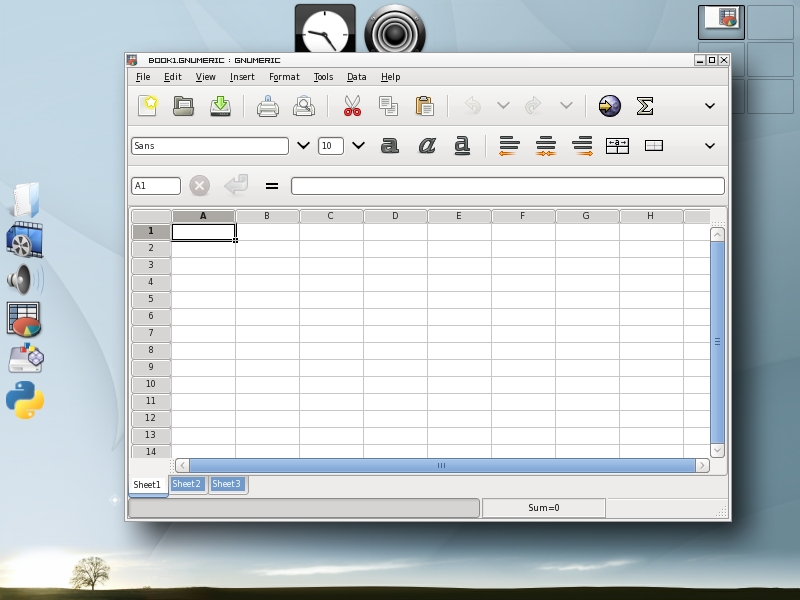
Figure 2. Enlightenment Desktop (E17)
Fedora also offers up-to-date PowerPC ISOs of every version, including the latest, Fedora 12. Fedora offers a more complete default installation and more application packages, but also is considerably more resource-intensive. It attempts to give a GNOME or KDE environment comparable to the x86 build of the same version. This means if you're used to Linux systems on x86, you'll be more at home with Fedora than with Yellow Dog, but it also means it's noticeably sluggish on older systems. Generally, I'd recommend Fedora for systems with a 1GHz or faster G4 or G5, and at least 512MB of RAM. It is important to note that support for Fedora on the PlayStation 3 is experimental and in a very early development stage, although there have been efforts to finish the port. Fedora 12 will be the last officially supported version for PowerPC, but there are efforts to provide community-supported PowerPC builds of Fedora 13 and later versions.
Ubuntu ended official support for PowerPC in late 2006 with Ubuntu 6.10. Since then, there have been PPC builds of every Ubuntu release developed by the community. These generally are very high quality and have excellent stability. Ubuntu has similar system requirements to Fedora, with most older hardware probably being too slow to handle it smoothly. Ubuntu also offers an ISO for the PlayStation 3, but it's still experimental and somewhat limited in features due to the PS3's insufficient amount of RAM, so using the live CD is likely to be unpleasant.
Itanium, also called IA64, was the last attempt by Intel to replace the aging x86 architecture, following the disappointing iAPX432 and i860 processors in the 1980s and 1990s. At one time, industry analysts considered it to be the future of the high-end servers, and Intel planned to use the architecture in personal computers eventually as well. Itanium uses a unique architecture, neither RISC nor CISC, that can execute several instructions per cycle in parallel. SGI and HP replaced their own high-end processors with Itanium out of the expectation that it would bring a revolution in performance. However, the first-generation Itanium core, code-named Merced, delivered disappointing performance results while consuming massive amounts of power and prevented the market-share breakthrough that Intel had hoped for.
With the release of the Itanium 2 core in late 2002, performance increased significantly, but the platform's reputation had been hurt by the low quality of the first-generation processors, and Itanium remains a high-end product with low market share. Intel still claims to be committed to the architecture. A new quad-core Itanium chip, code-named Tukwila, was released in February 2010, and according to Intel, at least two more generations are under development.
HP is the last major manufacturer of Itanium-based workstations, and it still makes more Itanium servers than all other companies combined. HP's workstations, the ZX2000 and ZX6000, are easily available secondhand and have excellent Linux support.
The only remaining commercial distribution with any focus on Itanium is SUSE Linux Enterprise Server. Red Hat offers a version of Red Hat Enterprise Linux for Itanium, but support for the platform will be ended in version 6. Red Hat Enterprise Linux 5 will be maintained and receive bug fixes until 2014, so if you don't mind missing out on feature updates, you can purchase a license from Red Hat. Red Hat also offers a free trial version, which blocks access to update repositories after 30 days.
If you have a large Itanium system or cluster, SUSE Linux makes a lot of sense due to its active development status and excellent support for virtualization, but for smaller installations and hobbyists, several other systems are available, including Gentoo and Debian. Fedora and Ubuntu both define Itanium as a secondary platform and occasionally provide new releases or updates, but both largely have ignored the architecture in recent releases. The last build of Fedora available for Itanium was Fedora 9, and Ubuntu releases for the platform have been broken or seriously buggy since 8.04. HP-UX, OpenVMS and Microsoft Windows also are available for Itanium.
Debian probably is the most stable and modern IA64 Linux distribution available for free. It still is an officially supported Debian platform, and still is under active development. It offers all the features of x86 Debian, including a full GNOME desktop environment. Debian for Itanium has access to the full Debian package set and generally is fairly stable. In recent months, development has declined somewhat due to declining overall interest in the Itanium platform, but it appears that IA64 will continue to be a supported platform for the foreseeable future. An occasionally active mailing list exists for users and developers of the Itanium port of Debian.
Red Hat and its derivatives occasionally have run on Itanium. Red Hat is preparing to release Red Hat Enterprise Linux 5.5, which will support the platform natively, but it might not be a good idea to run RHEL on a new Itanium system due to the fact that version 5 will be the last release available for IA64. CentOS, an open-source clone of RHEL, no longer supports Itanium, although the developers have suggested that future releases may run on it, as well as other less-common architectures including SPARC and Alpha. Fedora was available for Itanium through version 9, and some RPMs from version 10 are available. Overall, the Fedora experience on Itanium isn't bad with all updates installed, but users who want more up-to-date packages may end up needing to use source RPMs or compiling software themselves.
Of the platforms discussed in this article, Power and especially Itanium both have a questionable future. Although IBM and Intel are committed to developing future generations of their products, the market for high-end proprietary processors has been somewhat eroded by increasingly fast and cheap x86 processors. Many analysts felt that the Tukwila Itanium was underwhelming in comparison to both Power7 and high-end x86 server processors, such as recent Xeon and Opteron chips. IBM expects Power to be a viable platform for a long time, because it still is substantially faster than the x86 alternatives, but even for them, competition is closer than it once was. As a result, Linux support for these platforms probably is going to decline over time, although as long as there is hardware using these architectures, people will be using and developing Linux on them, as has happened with “dead” architectures, such as the DEC Alpha and the HP PA-RISC. ARM, on the other hand, has a bright future, having been dominant on low-power systems for decades and starting to become popular on consumer computer hardware, with constantly improving Linux support.
Resources
Scratchbox: scratchbox.org
Ångström: angstrom-distribution.org
Gelato: gelato.org
Ubuntu PowerPC Wiki: wiki.ubuntu.com/PowerPC
Kira Scarlett has been using Linux for eight years. She frequently ends up owning strange and unusual computer hardware, and she has used Linux on almost every major processor of the last 20 years. She also is interested in graphic design and is an avid hockey fan. Kira can be reached at kira_arc4@ovi.com.
