Linux in Amsterdam
In December, when I would otherwise have been preparing for this issue of Linux Journal, I spent a week in Amsterdam attending the First Dutch International Symposium on Linux. Linus, Remy Card, Matt Welsh, and several others spoke on a large variety of topics. I will mention here only a sampling of the presentations that were made.
By any measure, the Symposium was a success. Originally arranged to be held in an 80-person room, the symposium was moved to a 120-person room, and the organizers were still forced to turn people away. While many of the participants were Dutch, I believe that the majority were foreign. With participants from all over Europe and North America, and at least one participant from Japan, it was a truly international symposium.
Many of the participants in the symposium had never before met in person, but knew each other well through e-mail and usenet news exchanges. It is an interesting phenomenon to need to be introduced to a person you feel like you know well.
The Dutch are precise people. Their trains run on time, their museums close on time, and their conferences run strictly according to schedule. Each talk started on time. Five minutes from the scheduled end of each speaker's allotted time slot, a kitchen timer rang. Then at the end, five minutes later, it would ring again, and the speaker was allowed (in practice if not in theory) to finish his sentence. This second ring was called kill -9 by the conference organizers.
Matt Welsh gave the best exposition I have heard yet on how to port to Linux. Not satisfied with the standard answer that most (portable) programs written for POSIX, SVR4, SVR3, or BSD just compile (given the right compiler flags for BSD programs), he explained what kinds of non-portable code can and will cause problems and suggested ways for the listener to either get around the problem or let the listener know that the problem would take significant effort to code around.
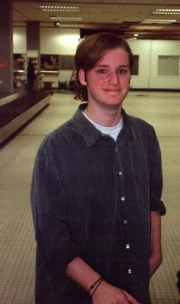
Matt Welsh, Schilpol Airport in Amsterdam
Remy Card gave a technical introduction to the Second Extended Filesystem, showing that there is room for further development of the filesystem built into the filesystem, so that as extra capabilities are added, people do not have to reformat their hard drives. He also explained some of the features that make it less susceptible to corruption than other filesystems.
I gave a talk on how I see Linux Journal affecting the Linux market, both in terms of available software and available jobs, and spent some time discussing Linux Journal in a question and answer session that was sort of like letters to the editor, only faster.
Michael Kraehe gave a presentation on Onyx, his Copylefted 4GL which he developed (and sells support for) under Linux. It can tie together many different kinds of databases (Informix, Ingres, Postgres, Yard, gawk, Shql, and others) with one data presentation. The 4GL language is more like a shell than other 4GLs, because system commands can be used; a report to print your bills could send the output of a command through a “gawk | groff | lpr” pipeline. It uses the standard Unix tools instead of replacing them.
Peter Braam, of Oxford, gave an explanation of how Linux is being distributed all around the very distributed Oxford campus without seriously compromising security, and without requiring students to become their own systems administrators on their own Linux machines, by using Kerberos for network authorization and SUP (Software Update Protocol, from CMU) for updating packages on students' drives.
A team designing a product called Viper, which is a spin-off of Linux which will provide full kernel threads in a package conforming to POSIX 1003.4a, presented the work that they have done so far and explained what is left to do.
Linus Torvalds (the originator, main guru, and “dictator” of the Linux project, for those new to Linux) gave two talks. The first, which opened the conference, was an introduction to Linux. The second closed the conference, was much more technical, and generated more questions. Linus kindly asked to be interrupted whenever anyone had a question, and the technical talk generated more interrupts than the overview.
He gave an interesting example of how freedom to re-think some assumptions that were made when the original Unix was written allowed a simpler design in Linux. In other versions of Unix, “sleeping” creates a race condition that can cause processes to go to sleep forever, unless interrupts are carefully disabled while going to sleep. Linux uses a slightly different paradigm than most unices (sleeping is done in two steps, first saying, “I'm asleep now” and then later actually going to sleep) which removes the possibility of the race condition without disabling interrupts, improving both performance and robustness.
Linus told us about several efforts underway, including his ongoing 64-bit port to the DEC Alpha. That port is still in its infancy, but is important in helping make the entire kernel more portable, because it uses 64-bit pointers (and 64-bit integers by default), which exposes non-portable code very effectively. Work is being done now to integrate the work being done on several ports into the mainline source tree, towards the goal of making Linux a true multi-platform operating system. “I'll make a [version] 2.0 someday, and the decision when to go to 2.0 is essentially when I have a stable release which is multi-platform,” he said.
Other quotes from Linus were both interesting and (usually) informative. I have included a sampling both of non-technical and technical quotes:
“While in Australia, Dennis Ritchie said that the one feature of Unix he was most proud of was that it was portable. When it comes to Linux, the one decision I am most proud of is not the actual physical design of the system, but the decision to make it free.”
“The most important design issue...is the fact that Linux is supposed to be fun....”
“Linux is a Unix clone for PC clones. The `PC clones' part I'm trying to fix, and others are trying to fix it as well.”
“[Linux] does endless loops in six seconds.”
“I'd [really like to] see Word for Windows under Linux....”
“....So, I obviously decided to make my own Unix. What do I need? I need lots of ignorance, because if you know too much, you know that it's obviously impossible. Then you need the arrogance—`yes, I can do it, and I can do it better than anybody else'. Those two you need to just get started... you need to be a bit crazy and actually go on with it...”
“Somebody from Novell commented that they had an alpha-testing lab of a hundred machines or so, and he said, `No wonder Linux works so well. He has an alpha-testing lab of ten thousand people!'—and that's true.”
“Ext2 is much better than the Minix filesystem.”
“There is a general move [to] getting kernel threads eventually, which could be the Viper threads, or could not.”
“Within, maybe, half a year, a year, I expect to see three reasonably supported different platforms for Linux. The 386 version will be the normal one, though, simply because everybody has one.”
Speaking of an improvement that may debut with 1.3.x: “The improved data cache essentially means that the data cache right now is indexed according to the device and block number on the device... In the long run, we want to make this indexed according to the inode and the offset of the inode, which makes it much easier for the VFS layer to look up a buffer, without the need to go through the low-level filesystem to find out the block number. It also makes it possible to do NFS caching (read caching, because write caching [NFS] is a no-no).”
Michael K. Johnson is the editor of Linux Journal, and is also the author of the Linux Kernel Hackers' Guide (the KHG).